The scribe that writes only what you actually said — and answers what you’d have looked up.
Pabaid turns the visit into a clean, concise note. No invented exams, no note bloat, every dose checked against its cited ceiling. And when a question comes up mid-visit, the answer arrives in seconds, with its sources named.
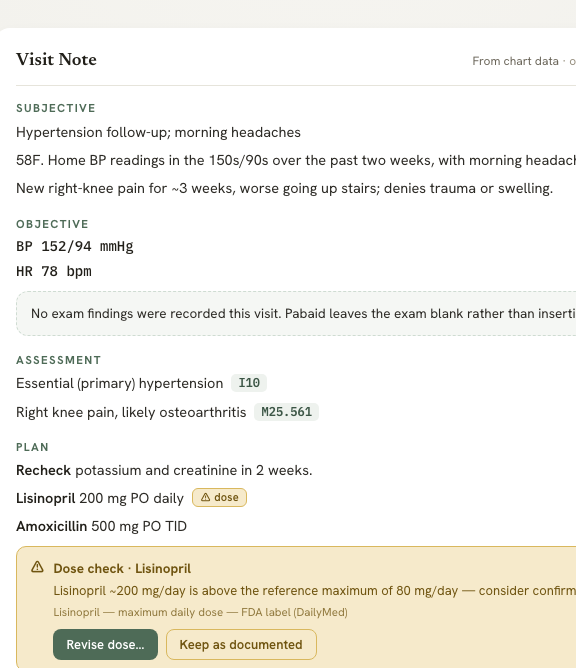
58F, hypertension follow-up. Morning headaches; home BP 150s/90s ×2 wks. New right-knee pain ~3 wks, worse on stairs; denies trauma. ROS otherwise negative.AI
- Thiazide, ACE-i/ARB, or CCB.
- Target <130/80.
- Reassess 2–4 wks; monitor K⁺.
Built around the three things doctors don’t trust AI scribes to do.
Scribes invent normal exams, bury the plan in paragraphs, and mis-hear doses. Pabaid was designed to do the opposite.
It never fabricates an exam
If you didn’t say it, it isn’t in the note. The objective section stays blank rather than templating a fake “normal” exam.
You see what was inferred
Anything Pabaid inferred rather than heard is highlighted, so proofreading takes seconds. Concise notes that read like you wrote them.
Every dose is checked
Drug names and doses are checked against cited reference ceilings and FDA boxed warnings. A 200 mg that should be 20 mg gets flagged before you sign.
The desktop charts. The phone answers.
You’re with the patient. Charting happens on the desktop; the reference lives in your palm.
Dictate the visit. It drafts as you speak.
One tap starts dictation (with the patient’s consent on record). Pabaid labels who said what, grounds every line of the note in the transcript, and stages ICD-10 codes as you go.
The answer’s already in your hand.
Install Pabaid to your phone’s home screen and the same cited answers travel with you. Ask a question in plain language and get a three-bullet, sourced reply in seconds.
Stop closing the chart to open a textbook.
Ask a clinical question in plain language and get a short, cited answer drawn from evidence-based guidelines. Every response shows the patient data it used and names its sources, so you can check its work.
- ✓Every answer names its source — USPSTF, AAFP, ACC/AHA, NICE.
- ✓Guideline cards surface themselves for the diagnosis on screen.
- ✓Seven regional frameworks built in — US, UK, Canada, Australia, NZ, Ireland, WHO — detected from where you practice.
- Begin at age 40, or 10 years before the youngest affected relative’s diagnosis — whichever is earlier.
- Colonoscopy every 5 years (vs. 10 for average risk).
Twenty clinicians are shaping Pabaid right now.
Their reviews will live here, unedited, at launch. Until then these seats are reserved — and a few are still open.
Built for protected health information from day one.
Encrypted in transit and at rest on HIPAA-eligible infrastructure, with a business associate agreement program in progress ahead of general availability. The strongest protection is architectural: Pabaid never needs a patient’s name to work.
Two weeks free. Upgrade when it’s saving you hours.
A scribe alone runs $79–$399 per clinician per month. Pabaid is the scribe, the reference, and the safety net — together:
- ✓Dictated notes with provenance highlighting
- ✓Dose ceilings, boxed warnings, allergy conflicts
- ✓Cited reference engine, 7 frameworks
- ✓Web + install to any phone
- ✓Everything in Solo, for the whole practice
- ✓Six seats under one bill
- ✓Shared patient continuity across the clinic
- ✓Priority support
Chart less. Look up nothing. See more patients.
Tonight’s charting doesn’t have to follow you home. Try the sample encounter right now, no account needed — then bring Pabaid to your next clinic day.